A visit to Turkmenistan is always going to be loaded with restrictions. Those restrictions in a country with an ironclad dictatorship mean that interactions with locals are going to be minimal. Any local person having an “unauthorised” conversation with a foreigner will inevitably attract unwanted attention from the authorities.
As a tourist in a bubble, that is on an organised tour and driven everywhere, there are always going to be severe limits on where and when you can go. I am not a person who likes to travel with organised tours as they tend to rob you of a lot of interaction with locals. There is always some superficiality in being a tourist in a country but travelling on public transport is often a great way to meet people. There is interaction even on the most basic level and some form of transmission of insight and understanding. But in Turkmenistan there is little choice. Organised tours are the only sort of travel that the government allows these days. Point to point transits used to be possible but even that is getting harder I hear.
The arrival process at 3am was fraught with red tape. To enter Turkmenistan, you require a Letter of Invitation. That is, you must be invited by a local to visit before you can apply for the visa. This is a system much used in Soviet times. The letter of invitation does essentially guarantee you a visa which you obtain on arrival. You head to one desk where the immigration person takes our passport and letter, sticks a flash looking visa in your passport, then puts it in a pile. He then presents you with a bill that you need to take to the cashier who takes your money and then gives you a receipt and then sends you back to queue for immigration once more to get your passport and visa, The bill we were presented with was for $US190. Steep. Strangely at the cashier desk we were then told the total had risen to $US254. Tired and confused we just paid it. I then overheard an English man having a go at the cashier next to us. “What’s that for?” he asked rather aggressively. “Is that just something extra you’ve added on for no particular reason?” He then marched back to the immigration people and demanded they make a copy of his paperwork
We then had to go through another queue to get our passports stamped. This was the longest wait of the night. We had expected to do a Covid test but when we approached that desk they waved us away. It seems they still charge for a test but don’t actually bother to do them anymore. The English guy ended up standing next to us in the passport queue and we got chatting. It turns out he was a tour guide who had been to Turkmenistan many times. He was an expert on the other Stans as well. He explained pretty much as we thought – that Turkmenistan was a place that looked often great on the surface but other flaws soon became apparent. His previous behaviour had made me think he would lay on the criticism but he was clearly someone with a passion for what he did and great empathy for the countries that he had led tours into, This should always be the gold standard for travelling anywhere, don’t expect things to be the same and go with the flow. Try and understand and accept rather than compile a list of criticisms.
Eventually we got to immigration. Max was first and had a bit of a questioning from the officer. He then had to submit fingerprints through a scanner. When I got there it was straightforward. “Was that last man your son?” he asked. He smiled when I affirmed it and apparently no fingerprints were required for the old guy. Then it all got easier as we delivered ourselves to our tour guide, Guvanch, and didn’t really have to worry about any logistics from there,

Despite the limitations of a guided tour, we got to see some interesting things along the way. The mad capital, Ashgabat, is something special in itself. It was a bit of North Korea meets Disneyland. A city built almost exclusively in white marble. In general, there is an obsession about white. All cars must be white (we did see the occasional silver one) and can be fined by the traffic police if they aren’t clean. In its relatively short history as an independent country since the collapse of the Soviet Union, Turkmenistan has had three presidents, The first Saparmurat Niyazov, more or less took over as he was the most powerful figure in the Turkmen Communist Party. He died in 2006 and was succeeded by a dentist, Gurbanguly Berdimuhamedov. He in turn passed the baton to his son in 2022 but remains a powerful figure in the background. Little has changed as the country is still a strict dictatorship with little press freedom and sham elections. The first president became so self-obsessed he changed the names of months of the year in honour of his family. He wrote a book, the Ruknama that was essentially to be the reference book on a par with the Bible or Koran. It has rather fallen out of favour since his death and months have reverted to normality.
Ashgabat is extremely clean and modern looking with roads many in richer countries could only dream of. It is well planned in many respects and despite the fact that many of the monuments are follies built at the expense of more practical needs, there are some great designs. Everything seems to incorporate an artistic design from streetlights to the fabulous horse’s head adorning the sports stadium. Even TV transmission towers have an artistry built into them. It makes me wonder why we can’t do that in Australia. But things must always be efficient and functional. Nothing wrong with that but more public art would be great if it could be incorporated. There are monuments to the constitution despite its irrelevance. But it beggars the question why can’t we have the Australian Constitution or Te Tiriti O Waitangi expressed in art? What character would a stadium have if a statue of a wedge tailed eagle rose above it?

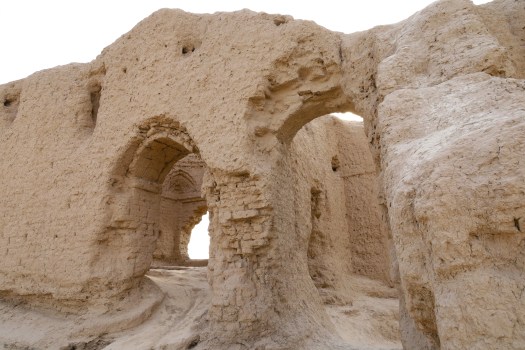
This is a part of the world that was on the Silk Road and thus at the crossroads of civilisation in its time. A city such as Merv was once pretty much the main city in the world. Most certainly at one point it was the biggest. Its construction and sophistication must have been quite amazing for its time. It was reportedly a cosmopolitan city containing people of varied faiths and ethnicities. Its destruction in 1221 by the Mongols was reportedly one of worst massacres known with up to 700,000 estimated to have been killed. The history can be read elsewhere but it challenges the imagination to see what must have existed here. Thes cities were built mostly of mud brick which was practical due to what was available and suited the conditions, but they don’t exhibit the same level of preservation that those cities built of stone in their ruination.
While Turkmenistan is heavily Muslim it’s not as pervasive as many other countries. It was effectively discouraged and discriminated against by the Soviet government and today there is a fair element of secularism to be seen. On the surface women appear to be conservatively dressed in traditional style which often includes a head covering but covering of the face seems relatively rare. Men appear to wear what they want but it is usually conservative There seem to be armies of men in black suits and ties to be seen walking to work in the morning in Ashgabat. No one wears shorts except foreigners so me flashing my legs in shorts and Birkenstocks tended to raise a few stares. They think you’re weird anyway as a foreigner, so I just ran with it. The women often look comparatively elegant and colourful. Taking photos of them is pretty much off limits sadly.
Amongst all the public artwork there is a palpable lack of individual expression. Nearly all houses are white with green rooves as it is decreed that the green reflects the national flag. When passing rows of them there is no sign of any difference. No individual ornaments on the exterior that would mark out one place as different. On the roads – cars in the capital are decreed to be white but it doesn’t vary a lot in the countryside. There is no pimping up trucks the way they do in India or many other countries. There is a definite lack of colour. We were never able to venture into anyone’s house to see how they might decorate the inside. Wall artworks hang in every hotel room. These are largely average paintings of horses – the emblematic animal of Turkmenistan. This is one of the aspects that really shows how oppressive the regime is. How awful to be born with a spirit of creativity or adventure in such a stultifying place. Order and uniformity are the prevailing characteristics.

The internet is heavily restricted with nearly all social media platforms blocked. When we stayed in a flashy hotel in the last two nights in Ashgabat, we suddenly had unrestricted access to Facebook, Instagram and WhatsApp. The hotel had it’s own power supply which might explain why it was able to run the internet connection independently too. The last day in Ashgabat involved a visit to a giant Ferris wheel. We were the only ones there and they started the thing up and we took a ride. Just for us! Designed to look better from the outside, it lacked practicality for riders who had quite a restricted view. The worst part was at the top where the most memorable view was some dead pigeons -the structure blotted out much of the external view. In the area below, was a children’s play area with a tiny merry-go-round and some basic attractions. Actually quite colourful but eerily empty There was something very North Korea about that experience.

Our drive northwards to the Darvaza gas crater and ultimately, the border, was hard. This was mainly due to the socking condition of the road. It started badly and got progressively worse. The last 265 km took six hours of bone rattling pothole slaloming. The crater itself looked far more impressive by night. It was the last of three craters we saw that were the result of drilling accidents. All of them had involved deaths when the ground collapsed, gas was still leaking from all of them but the Darvaza fire crater is still burning after its formation in 1976.

The last stop were the ruins of Konye Urgench, a mixed bag of structures built and destroyed over centuries. The most impressive structure was the Kutlug Timur minaret that is 60m tall. Our thoughts were occupied by the imminent border crossing to Uzbekistan which is fairly isolated and doesn’t get much traffic. I had worried about the chance of getting stuck as there as there might not have been transport the other side. As it was, I needn’t have. We were dropped at a gate which was probably 800m from the border office itself. There the guards were very friendly and eager to practice English. We needed to walk that distance under the strong midday sun. This brought back memories of old style overlanding which always involved a walk or donkey cart ride through no man’s land. Thankfully we still had our guide with us who navigated through customs and immigration. There is always an extra guard who acts as a passport snatcher. He watches the immigration officer stamp your passport but is still required to snatch it from you aggressively just to check it again.

It was a comparatively short walk to the Uzbek side. Clearly these guys didn’t see many punters during the course of the day. They were relatively friendly but kept you as long as they could to avoid complete boredom. A man in a cubicle checked our temperatures and waved us on. The immigration guy took my passport and stared at his screen for nearly five minutes. What that was about I don’t know. After that he stamped my passport and went to hand it back to me only to stop when his interest was taken back to the screen. Two more minutes of intense screen staring followed before he finally gave it back to me. The final customs check was undertaken by a very friendly women. She was drawn to the two bags of pills I carry with me – everything from statins to antibiotics. She asked if I had any psychotropic drugs as they have a bugbear about that in Uzbekistan. Apparently if you are a bad sleeper you’ll never be able to get help from a doctor there. She kept us long enough to practice more English. There was of course a final meeting with the Uzbek passport snatcher who had to rifle through mine three times before he could find the entry stamp. In fact, I had to take (not snatch) it back off him to show him where it was. With that we were through. Goodbye Turkmenistan.


 Wandering and wondering
Leave a reply to Jackie Furby Cancel reply