This was the country we were going to spend the most time in. Given its famous historic sites – such as Khiva, Samarkand and Bukhara. There was more of course – looking at the ships stranded from the destruction of the Aral Sea, the Savitsky gallery in Nukus and seeing what Tashkent, the capital, was like.

We’d crossed the border from Turkmenistan to Nukus a bit exhausted from the last two days of travel along the horrendous roads of the north of that country. We had booked a two-bedroom apartment with an all-important washing machine. Nukus was quite unremarkable but pleasant. Our apartment was in a block opposite the Savitsky gallery. Igor Savitsky collected many examples of Soviet dissident art or at least art that was banned at the time and managed to secret it away in this remote corner of the Soviet Union. It now stands in his honour and it made for an interesting visit.

The other main attraction in Karakalpakstan, as this part of Uzbekistan is called, is the town of Moynaq – now a remnant of an ecological disaster. In their manic quest to massively increase cotton production in the Soviet Union huge amounts of water were diverted and, to cut a long story short, this led to the destruction of the massive Aral Sea. What remains is a sad desert town from what was once a vibrant fishing port. Massive amounts of pesticides used in cotton production appeared to have found their way into the Aral Sea and consequently into the toxic dust that is now left. All that is left now are the rusting ships stuck in the desert. It is a sad and eerie place with a trickle of tourists to gawp at the sobering wrecks. This what happens when the environment is treated as a free lunch and those who seek to exploit it are not held to account. As I said in a social media post there is often an assumption that countries that are poorer or “less developed” are seen as reflective of our past but here I saw our future. There will be more of these disasters in years to come.

On to Khiva via one of the ruined old forts that are left this area of the country. Khiva is compact and well preserved but while it has a lovely old quarter with some beautifully preserved and restored structures, it also feels a bit DIsneynified. Loads of tourists gather here which leads to an amusement park atmosphere rather than a living old city. What struck me most was the age of the tourists we encountered. Most I’m sure, were older than I am, and Italians appeared to be the main nationality. A friend who was a doctor to a group of elderly tourists visiting agreed. He likened it to the doors of nursing homes in Europe being flung open and the residents sent to the Stans. Khiva is certainly a nice place with an attractive set of monuments, but there was very much a sinking feeling that Uzbekistan is well on the way to industrial tourism. I think I got here fifteen years too late.

One of the most humbling things for me visiting this part of the world was how narrow much of my history studies have been. As a student of modern history, especially modern economic development, it is easy to forget how this part of the world – the famed Silk Road – was for so long very much the centre of world trade and development.
The long car journeys were taking their toll. I thought about flying from Urgench to Bukhara to avoid six hours in the car. A look at Skyscanner showed three separate flights of Urgench to Tashkent then Tashkent to Istanbul then Istanbul to Bukhara – nuts! That was thirty hour journey. I’ve always found that site great but a look at the Uzbek Airways site showed tickets available for a direct flight of less than an hour for $70. So, we went with that. The nuisance of flying soaks up some more hours but it was worth it. The airline is fine but it did have one of the grumpiest flight attendants. He would hand a drink to the person in the aisle seat and bark Send! at them. This was meant to mean they would need to pass it on to others in the row. If you didn’t get that the first time around he barked even louder the second time with a large dose of angry condescension. Bukhara was nice with significant ancient structures reflecting its historical importance. With ancient buildings also came a large contingent of tourists. Two things put a bit of a dampener on proceedings. One was a day of rain and a bit of a chill that left a bit of a depressing feeling. Added to that my back, which had not been great since I left Australia, began to flare up badly. I was getting terrible spasms of pain when I moved and none of the usual painkillers seemed to work. I felt completely crippled. In desperation I went to a local medical clinic. I was surprised that I seemed to be a real novelty as I thought they would have steady stream of foreigners given the numbers, and age, of them. After much chaotic fussing around I got to see a doctor. She did not speak English and our Russian had not proved particularly adequate so far on the journey. With a fair amount of confusion and Google Translate we were able to get through. She addressed most of the conversation to Max asking him: How old is your father? Is he forty-five? Brownie points on that one. I guess most males my age in Uzbekistan are dead. She then dispatched Max to the downstairs pharmacy for a bunch of medications. There was a course of injectables which she gave to the nurse to administer. Some instant relief! There were four left to take away and administer myself. I later looked them up and saw they were just Diclofenac. Hardly super strong stuff but I was well on the road to recovery.
Still sick of cars and shared taxis, I managed to get train tickets for two of the legs of our journey. Not with the flash new high speed rail trains but more of the clunky old variety. I always love to travel this way and it was comfortable and pleasant enough. The usual aversion to sharing information is always a challenge in this part of the world but luckily the trains were nowhere near as bad as the buses or planes. Urgench Airport must be one of the worst in this regard. Passengers swarmed into the check in area where all the lights had been switched off and stood in confused silence waiting for some sign of life or maybe even a screen somewhere that might shed light on what was happening. Airport staff and officials were particularly unhelpful, shooing you off if you dared to approach them. Eventually the lights came on to wild applause from the largely Italian crowd of assembled confuserati. The mess eventually resolved but the pointless desire to not even bother to display information was inexplicable. Just goes to show people think differently wherever you go.

Next stop was Samarkand. This city probably has the most romantic name of any along the old Silk Road. There were very few hotels in the centre, so we stayed a bit further out. Distance was never too much of an issue anyway given our discovery of Yandex Go, the ride sharing service in this part of the world. It is incredibly cheap, so God knows what the poor divers get paid. I would always include a tip but the really good thing about it was not dealing with taxi drivers directly. This, in my experience, in every part of the world inevitably leads to arguments about the price and rip offs. Arriving in any place and confronting the usual horde of aggressive drivers is never fun. It took a bit of getting on this app but I was so pleased we cracked that one early on. It can be annoying at times finding one, just like Uber, but I would definitely recommend it to anyone visiting this part of the world. I’m not being paid to say that either, but I’m open to offers.
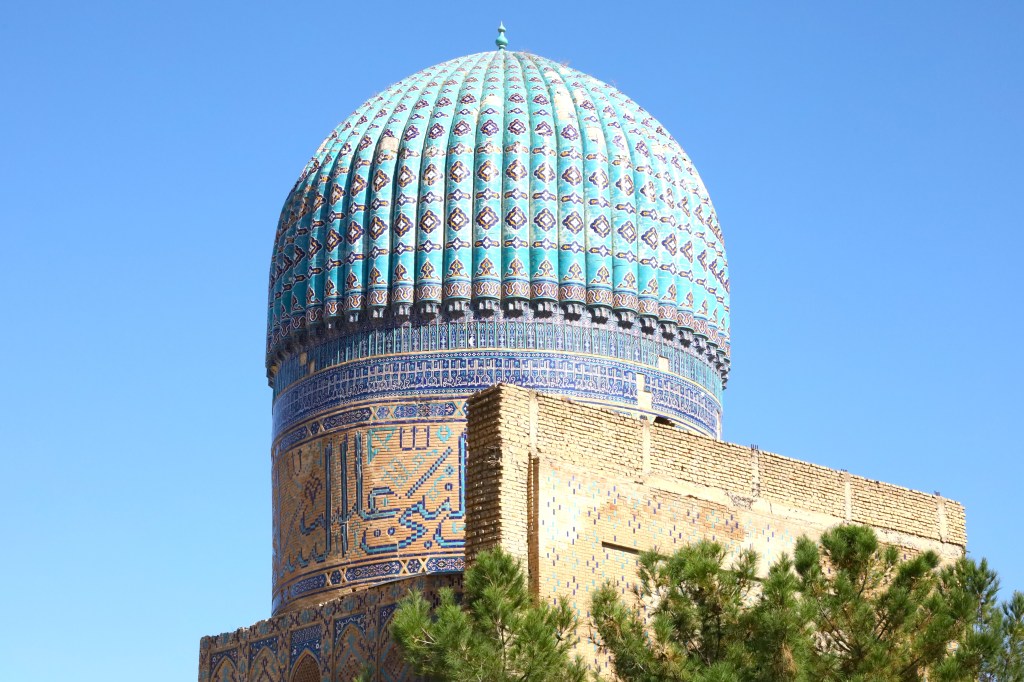
Anyway, on the first morning in Samarkand we walked into the centre through a quite lively and engaging city perimeter. It had the feel of a reasonably sized working city for a change. While they were heavily touristed, the sites were stunning. They have been restored but you would think that this has largely been done well. The centrepiece, called the Registan, is quite beautiful. While there were quite a few tourists there and we had to queue to buy tickets, the site itself was large enough that we could walk around quite freely and not fight through crowds. There were several sights that were large and quite beautiful too but probably the Shah-i-Zinda mausoleum was the one that caught our attention the most, although that was more compact and involved a bit more jostling with Chinese tourists.
From there we took the train to Tashkent, the capital. It was nice to walk through the city’s green spaces, unfortunately two of its larger museums were closed for renovation. I was looking forward to its rail museum to see some old Soviet locomotives. It had a couple of good examples but it had been a bit painted up for the kids and so was slightly underwhelming. One of my favourite sites was the Cathedral of the Assumption which was a beautiful building. Sadly, I wasn’t able to use my good camera in there. We rode the metro where possible, probably not up to that of Moscow but the stations have nice lights and murals. Thankfully, they have rescinded the ban on taking photos that was in force for so long.
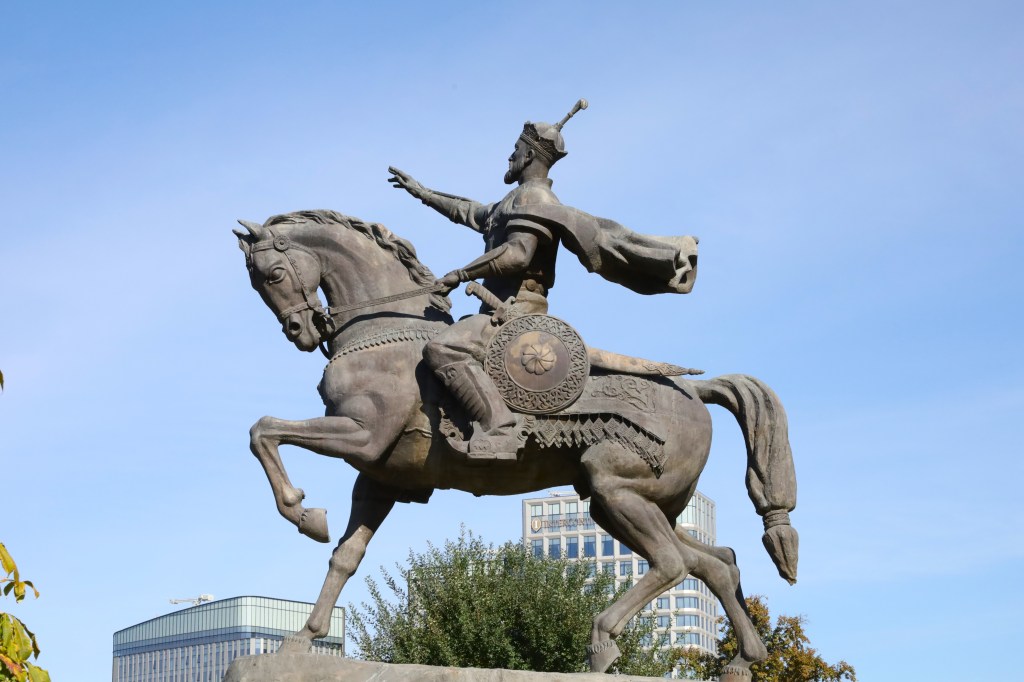
We were interviewed by students in the main square obviously practising their English. Max was not keen, so I volunteered to answer banal questions about my daily habits. What do you do when you first get up in the morning? I declined to answer the truth which is usually running to the crapper to unload even before I’d ground the beans for my first cup of coffee. I made the standard praise of saying how wonderful Uzbekistan was. The second group were less ambitious with their questions. Have you tried plov? What do you think of it? I had to be diplomatic. Not that there is anything wrong with their national dish but there is only so much you can eat before it jades the tastebuds. Perhaps some of this may eventually end up on YouTube.
Overall, there was a feeling of being on a tourist conveyer belt. Uzbekistan has really cashed in on its sites and they are indeed impressive. Of course, we had come long after the Soviet disintegration but for some reason I had naively thought tourism would not have been at quite the level it was. The Europeans, especially the Italians and French, seem especially drawn to it and visit in large numbers. The reality is that this happens everywhere eventually and it is certainly not on the scale it is in Europe.
This underwhelming feeling as we left which is quite unfair really given the immense and interesting history of the place. While our one-month trip was always going to the four of the Stans was always going to be inadequate, I would not really hurry back to Uzbekistan. We did not explore the Fergana Valley which is probably a little bit off the main tourist highway and the gateway to Tajikistan which we did not have the time to see.
 Wandering and wondering
Leave a comment